What Is a Hydraulic Torque Wrench and How Does It Work
What Is a Hydraulic Torque Wrench and How Does It Work
In heavy industries such as oil and gas, wind power, petrochemical plants, and mining operations, large bolts must be tightened with precise force.
Traditional manual tools are often unable to provide the high torque required for these demanding applications.
This is where the Hydraulic torque wrench becomes essential equipment.
A hydraulic torque wrench is a powerful industrial tightening tool designed to apply accurate and repeatable torque to large bolts and nuts.
By using hydraulic pressure to generate rotational force, these tools allow technicians to tighten fasteners safely, efficiently, and consistently.
Understanding the Basics of Hydraulic Torque Wrenches
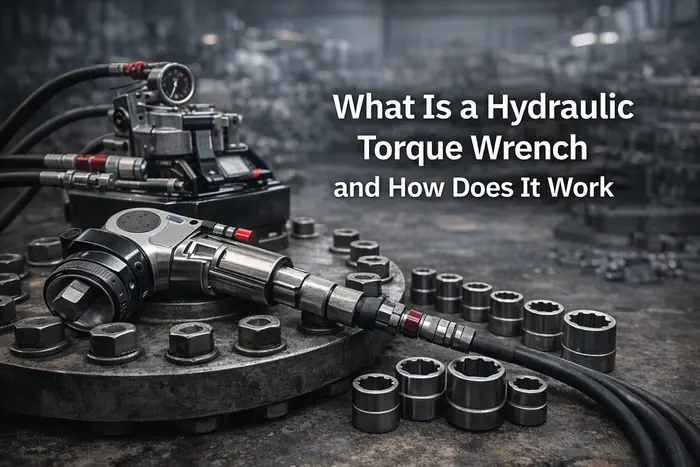
A hydraulic torque wrench is a specialized bolting tool powered by hydraulic pressure.
The tool is typically connected to a hydraulic pump through high-pressure hoses.
When the pump delivers hydraulic oil under pressure, the wrench converts this hydraulic energy into controlled rotational torque.
This process allows operators to tighten large industrial bolts that would be impossible to handle with manual tools.
Hydraulic torque wrenches are widely used in industrial maintenance, equipment assembly, and heavy machinery installation.
Main Components of a Hydraulic Torque Wrench
To understand how this equipment works, it is important to look at its main components.
Hydraulic Pump
The hydraulic pump provides the pressure needed to drive the torque wrench.
Pumps can be electric, pneumatic, or manual depending on the application.
They control the pressure output that determines the final torque applied to the bolt.
Hydraulic Hose
High-pressure hoses connect the pump to the torque wrench.
These hoses transfer hydraulic oil safely and allow flexible movement during operation.
Drive Unit
The drive unit is the core part of the torque wrench.
It contains a piston mechanism that converts hydraulic pressure into mechanical movement.
This movement rotates the wrench head and tightens the fastener.
Reaction Arm
The reaction arm stabilizes the wrench during operation.
It absorbs the counterforce generated during tightening.
Without a reaction arm, the tool would rotate uncontrollably.
How Does a Hydraulic Torque Wrench Work
The working principle of a hydraulic torque wrench is based on hydraulic pressure and mechanical force conversion.
Step 1: Hydraulic Pressure Generation
The hydraulic pump generates high pressure by pushing hydraulic oil through the system.
This pressure travels through the hose and reaches the torque wrench.
Step 2: Piston Movement
Inside the wrench, hydraulic pressure pushes a piston forward.
This piston movement activates the internal ratchet mechanism.
Step 3: Rotational Torque Output
The ratchet mechanism converts the piston movement into rotational force.
This rotation turns the socket and tightens the bolt.
Step 4: Repeatable Torque Control
Once the desired pressure level is reached, the torque applied to the bolt is controlled precisely.
This ensures consistent and repeatable tightening results.
Advantages of Using Hydraulic Torque Wrenches
Hydraulic torque tools provide several advantages compared with conventional tightening methods.
High Torque Output
Hydraulic torque wrenches can generate extremely high torque values.
This makes them ideal for large industrial bolts and heavy equipment maintenance.
Accurate Torque Control
Because torque is directly related to hydraulic pressure, operators can achieve very precise tightening results.
This is essential for critical applications where bolt integrity affects safety and equipment performance.
Improved Workplace Safety
Using hydraulic tools reduces the need for excessive manual force.
Technicians can tighten large fasteners safely with less physical effort.
Higher Operational Efficiency
Industrial maintenance tasks can be completed faster when using professional bolting equipment.
Hydraulic torque wrenches help reduce downtime and increase productivity.
Common industrial applications
Hydraulic torque wrenches are widely used across multiple heavy industries.
Common applications include pipeline flange tightening, wind turbine installation, refinery maintenance, and mining equipment assembly.
These environments require reliable industrial torque wrench systems capable of handling extreme loads and harsh working conditions.
Choosing the Right Hydraulic Bolting Tools
Selecting high-quality hydraulic bolting tools is essential for safe and efficient operations.
Professional manufacturers design torque equipment with precision machining, durable materials, and strict quality control.
Reliable torque tools ensure accurate bolt tightening and long-term operational stability.
SAIVS provides advanced hydraulic torque wrench systems and industrial bolting solutions designed for demanding engineering environments.
If you are looking for durable torque tools, customized bolting solutions, or competitive supplier pricing, our technical team can provide professional recommendations and product support.