How Does a Hydraulic Bolt Tensioner Work?
In heavy industry, structural engineering, wind energy, and petrochemical processing, massive high-pressure bolts secure critical infrastructure where standard hand tools fall short. Many technicians and engineers often ask: how does a hydraulic bolt tensioner work? Unlike traditional torque wrenches that twist a nut against heavy thread friction, a hydraulic bolt tensioner applies direct axial stretch to the bolt, ensuring exact clamping force without friction interference.
Understanding the mechanics of hydraulic bolt tensioning helps maintenance teams achieve uniform fastener loads, prevent gasket leaks, and eliminate joint failures in demanding industrial environments.
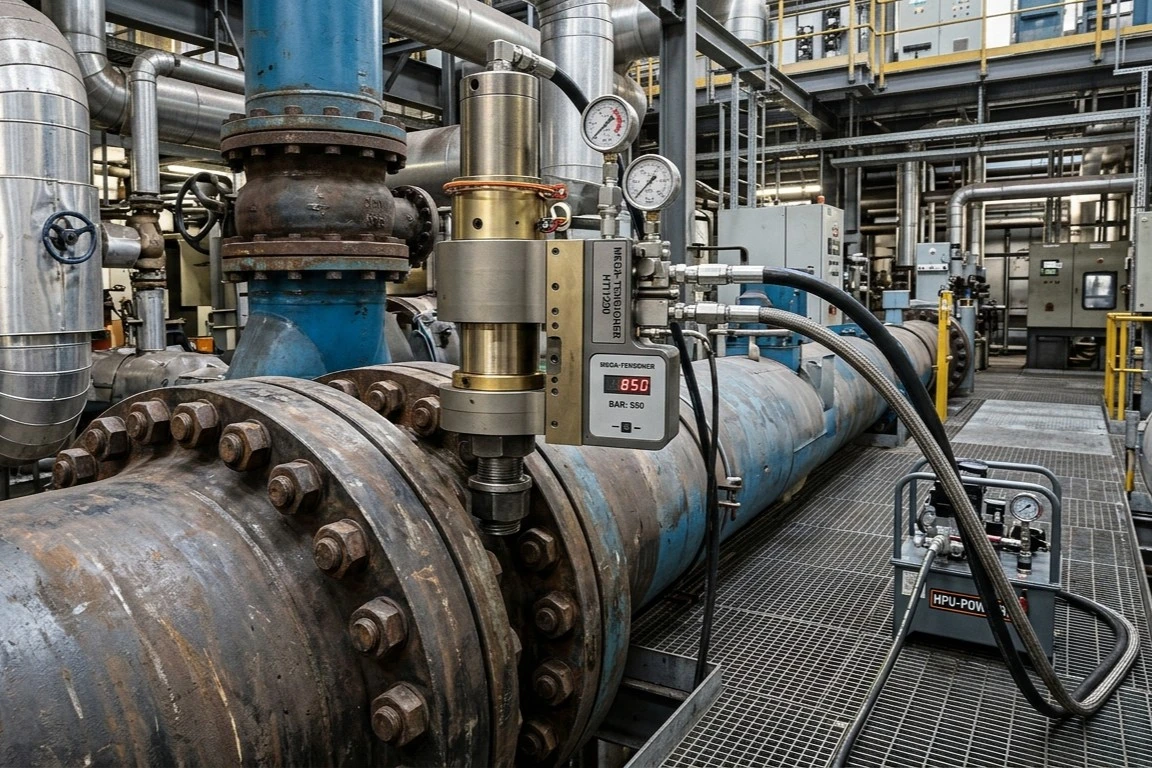
The Core Principles of Hydraulic Bolt Tensioning
To understand why tensioners are uniquely effective, it helps to look at how they interact with the fastener during installation.
Eliminating the Friction Problem
When you tighten a bolt with a standard wrench, roughly 90% of your effort is wasted fighting friction between the threads and under the nut head. Only about 10% of that energy actually stretches the bolt to create clamp load. A hydraulic bolt tensioner bypasses this friction entirely by pulling the bolt straight up along its vertical axis, stretching the steel shaft like a spring before any rotational force is applied.
The Role of High-Pressure Hydraulics
A hydraulic tensioner consists of a heavy-duty steel puller sleeve, a hydraulic load cell, and a bridge. Connected to an electric or pneumatic hydraulic pump, high-pressure oil flows into the tensioner's internal chamber. As the hydraulic pressure rises, it pushes the piston upward, stretching the bolt precisely to the engineering specification.
Step-by-Step Operation of a Bolt Tensioner
The tensioning process is a precise, multi-step sequence designed for maximum mechanical accuracy and safety.
Step 1: Placing the Tensioner and Socket
The technician slides the hollow hydraulic tensioner over the protruding end of the bolt or stud. A specialized puller sleeve engages the top threads of the bolt, while a bridge rests firmly against the joint flange to provide a stable reaction point.
Step 2: Applying Hydraulic Pressure to Stretch the Bolt
The operator activates the hydraulic pump, sending high-pressure oil into the tensioner. As the hydraulic pressure increases, the piston rises, pulling the bolt upward and stretching the steel shaft by a fraction of an inch (its precise elastic limit). Because there is no rotational turning, zero thread friction is created during this stretch.
Step 3: Seating the Nut and Releasing Pressure
Once the bolt is stretched to the correct elongation, a small manual socket built into the tensioner (or turned via a tommy bar) is used to spin the nut down effortlessly until it rests flush against the flange surface. Finally, the hydraulic pressure is released, and the tensioner is removed. The nut now holds the bolt securely in its stretched state, maintaining optimal, permanent clamp load.
Advantages of Using Hydraulic Bolt Tensioners
For extreme applications, hydraulic tensioning offers unmatched engineering benefits over traditional torque tools.
1. Absolute Precision and Uniform Clamp Load
Because clamping force depends entirely on direct steel elongation rather than unpredictable friction coefficients, every bolt tightened with a tensioner receives the exact same preload, preventing uneven gasket crushing and joint tilting.
2. No Galling or Thread Damage
Since the nut is turned by hand while the bolt is suspended under tension, there is zero rotational friction against the mating threads, completely eliminating thread galling and bolt wear.
3. Safety and Speed During Maintenance
Hydraulic Tensioners allow operators to tension multiple bolts simultaneously using linked pump manifolds, drastically reducing shutdown times during critical industrial maintenance turnarounds.
Achieving Excellence with Professional Equipment
Success in industrial assembly relies on selecting robust tools and maintaining them with high-quality supplies engineered specifically for the demands of your work environment.
Engineering for Consistent Results
When operating high-pressure systems or assembling critical machinery, you need equipment designed to eliminate guesswork. Robust torque tools, precision-calibrated gauges, and reliable fluid power systems ensure accurate force application. Saivs focuses on providing reliable bolting solutions—from manual torque wrenches to advanced heavy-duty hydraulic equipment—that help technicians achieve exact specifications every single time.
Expert Support for Your Tooling Needs
Selecting the ideal tightening method, understanding bolt stretch calculations, or establishing proper calibration routines requires a clear understanding of mechanical dynamics. If you need assistance with equipment selection, custom tooling, or assembly procedures, consult with experts who understand industrial bolting. Professional guidance ensures that your hardware investments protect your operational safety.
Trusted Solutions for Industrial Excellence
For professionals demanding the best in measurement and assembly, Saivs offers a comprehensive range of industrial equipment. Their commitment to engineering quality and reliability helps keep projects on track and within strict specifications. By choosing Saivs, you invest in precision, durability, and the long-term success of your operations.